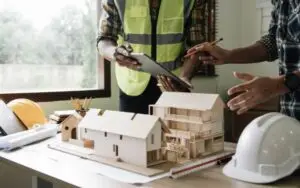
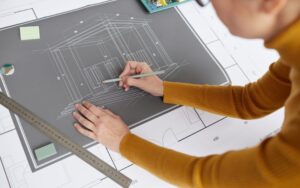
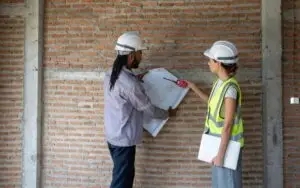
Any building project that may succeed beforehand must have one step that determines how the rest of it will go smoothly, such as site knowledge. Regardless of how attractive a design may appear on paper, it has to work in real life. We need a thorough site survey.For both homeowners and developers, working with competent home planners like HB Planning Services is the best bet, as the site survey will be conducted properly and incorporated into the design process.
What is a site Survey?
A site survey is an extensive evaluation of a piece of land or property. It collects accurate data on the location’s physical features, and no design is completed until this is done.
This typically includes:
- Measurements of buildings and land.
- Ground levels and slopes.
- Current systems and lines.
- Access points and features around.
The aim is to have a clear, precise image of the site to enable architects and planners to be confident in their design.
Why Site Surveys Matter in Design
The architecture design is not simply a matter of creativity- it is a matter of functionality. A design not based on the site’s reality may result in delays, additional expenses, or even the rejection of planning permission.
An adequate site survey can be used to make sure that:
- Designs are life-like and constructable.
- Plans are of the same size as the property.
- Problems that may arise are detected early.
This will prevent expensive future errors in the project.
Accurate Measurements Prevent Problems
One of the largest hazards in construction is working with incorrect measurements. Minor mistakes can lead to significant problems once construction begins.
For example:
- Extensions can not fit within boundaries.
- Structures can be incompatible with the existing features.
- Materials can be inaccurately measured.
A site survey is a detailed assessment that eliminates guesswork and provides solid data to support design and construction.
Understanding Ground Levels and Topography
Sites are not all plain and simple. Any alteration at ground level can affect a variety of issues, including drainage and structural stability.
A site survey will determine:
- Slopes and gradients
- Uneven ground
- Potential drainage challenges
The information enables designers to plan foundations, layouts, and water management systems effectively.
Supporting Planning Permission Applications
Planning applications must include the correct, up-to-date site drawings. This information helps councils to evaluate proposals.
Unless there is an appropriate survey:
- Plans can be rescheduled or postponed.
- Additional data can be asked.
- Love, the process may be longer and more complicated.
By engaging professional services such as HB Planning Services, it will be easy to ensure the accuracy of all submitted plans and their suitability to local authority requirements.
Identifying Site Constraints Early
Each site has its limitations. These could include:
- Nearby buildings
- Features or trees that are shielded.
- Access restrictions
These limitations are pointed out in a site survey before starting design. This enables early adjustments rather than waiting until it is under construction, and the changes will be costly.
Improving Design Efficiency
With precise site information, architects can work more effectively. They will not have to make assumptions; they can focus on designing structures that fit well within the available space.
This leads to:
- Faster design development
- Fewer revisions
- Improved general planning of the project.
Design efficiency can be easily converted into construction efficiency in the future.
Enhancing Communication Between Teams
A site survey is a common denominator for all project participants, including architects, planners, builders, and clients.
Having clear and accurate information:
- All work on the same information.
- Misunderstandings are reduced
- Making decisions can be done more confidently.
This enhances project coordination and helps keep the project on time.
Reducing Unexpected Costs
One of the key factors that leads to an increase in construction costs is unexpected problems. A large number of these issues may be due to insufficient site information.
Investing in an in-depth survey, you will be able to:
- Early detection of possible difficulties.
- Plan solutions: Plan solutions ahead of time.
- To avoid the expensive changes in construction.
This enhances budgeting accuracy and minimizes financial risk.
Supporting Better Use of Space
The building should be well-designed to utilize space effectively. To do this, designers must know the precise site layout and location.
A site survey assists this:
- Maximize usable space
- Position buildings effectively
- Improve overall functionality
This ensures the design that will be developed is practical and efficient.
Essential for Renovations and Extensions
Site surveys are not only significant when constructing new buildings; they are equally important when renovating and extending a building.
In working with existing structures, it is important to know:
- Present sizes and structure.
- Structural conditions
- Relationships between traditional and new aspects.
Proper information would ensure that the new additions fit into the existing property.
A Key Step for Long-Term Success
Avoiding a site survey or failing to take the time to complete one can be beneficial in the short term, but disastrous in the long term. The initial step of ensuring that proper information is collected will lay the groundwork for a successful project. With the help of HB Planning Services, you will be able to have a complete survey of your site, a reliable survey, and one that meets your design objectives.
Final Thoughts
One of the crucial phases of architectural design is a site survey. It provides the facts needed to develop viable, factual, and constructive strategies. Knowing your site helps minimize risks, improve efficiency, and increase the likelihood of a successful project.
FAQs
-
What is a site survey?
It generally involves measurements, ground levels, boundaries, and details of existing structures.
-
Do small projects need to be surveyed?
Yeah, even small projects benefit from accurate measurements and an understanding of the site.
-
Am I able to conduct a site survey myself?
Simple measurements might be provided; however, professional surveys are more correct and precise.
-
What is the benefit of a site survey for planning permission?
It verifies the accuracy of submitted plans and ensures they comply with local authority requirements.
-
What is the timing to do a site survey?
Before any design is finalized, or an application to plan is made, it has to be filled in.